What Cal/OSHA's Heat Illness Investigations Show
381 published workplace heat illness investigations describe a California death or hospitalization since 2010. Farm crews lead the files, firefighters are second, and 94% of the events fall in May through September — and what gets cited after a hospitalization is not what heat enforcement usually cites.
Cal/OSHA’s heat standards say what employers must do. The investigation files record the heat illnesses serious enough to be reported and investigated. This page is CompliantCA’s analysis of the 381 published workplace heat illness investigations in California with events from 2010 through 2025 — each one a death or a serious illness that had to be reported, was investigated, and whose case file has been released into the federal investigation data. Thirty-nine describe a death.
These are closed, published cases only — investigations publish years after the event, so recent years are structurally incomplete. What sixteen years of closed cases can say — who this happens to, when, what it looks like, and what gets cited after — they say clearly.
Who the cases describe
By the industry on the investigation record:
| Industry | Investigations (of 381) |
|---|---|
| Agriculture, forestry, and support (sector 11) | 97 |
| Construction (sector 23) | 76 |
| Public administration — including fire protection (sector 92) | 61 |
| Administrative, support, and waste services — including landscaping (sector 56) | 42 |
| Couriers, postal, and warehousing (sector 49) | 17 |
| All others | 88 |
Farm work leads. The single largest industry in the files is farm-labor support services (NAICS 1151) — harvest crews, often employed through labor contractors — with 73 of the 381 investigations. Agriculture and construction, the two industries that also lead §3395 citations, together account for 45% of the case files.
Firefighters are the second-largest single industry — fire protection (NAICS 9221) holds 49 files, spanning wildland fires, structure fires, training hikes, and drills. Public employers are fully covered by Cal/OSHA, and §3395 applies to all outdoor places of employment — but firefighting is not on §3395(a)(2)’s list of industries subject to the high-heat procedures, a list written around agriculture, construction, landscaping, oil and gas, and heavy-materials transport.
Delivery work appears in seven files, including the starkest in the set:
At 4:15 p.m. on June 17, 2021, an employee was working as a letter carrier… He was delivering mail on his mail route. He lost consciousness in front of a customer’s home. He was taken to the hospital. He died the following day from heat stroke.
At 7:38 p.m. on August 20, 2020, an employee worked to dig a trench for an underground electrical conduit. While working, the employee began to feel ill while working in the outdoor heat and was killed due to suspected hyperthermia.
The nonfatal files read differently — often as the emergency-response provisions working partway:
The employee reported to [her foreman] that she had a headache, was sweating excessively and felt nauseated. [He] took the employee to sit in the shade and instructed her to… [drink] water… placed wet rags on the employee’s forehead… [and a supervisor] then called 911.
That employee was harvesting radishes; she survived — someone noticed her symptoms, moved her to shade, and called 911. Noticing and responding are exactly the subjects of §3395’s observation, acclimatization, and emergency-response subsections — and, as the citation data below shows, they are what inspectors most often found wanting after the events that ended worse.
Events cluster in May through September
| Month | Investigations |
|---|---|
| January | 2 |
| February | 0 |
| March | 1 |
| April | 8 |
| May | 30 |
| June | 76 |
| July | 108 |
| August | 107 |
| September | 37 |
| October | 9 |
| November | 2 |
| December | 1 |
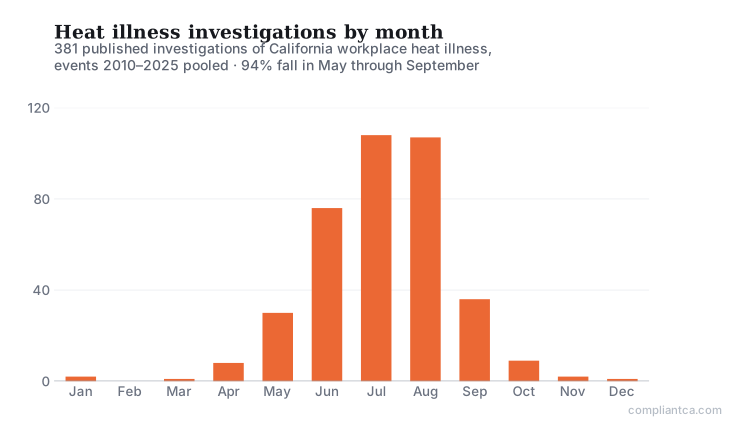
358 of the 381 events — 94% — fall in May through September, and July and August together hold more than half. This is the operational case for the timing the regulation itself implies: §3395(h) requires training before work that risks heat exposure, and §3395(g) puts the acclimatization watch on the first hot spell and the first two weeks of a new assignment. The season’s shape says that preparation belongs in April, not July. (Note the seasonality of events is nearly the inverse of the seasonality of citations — heat citations peak in January, because the median citation issues about four months after an inspection opens.)
Indoor heat appears in the files in small numbers with a sharp edge: three events describe indoor heat illness — one from 2011, long before an indoor standard existed, and a 2024 death in an unventilated workspace, an event falling after §3396, the indoor standard, took effect in July 2024.
What gets cited after a hospitalization or death
Our citation data covers citations issued from 2020 on — the accident files reach back further, but what got cited after them does not — so this section covers the 89 investigations with events from 2020 through 2025. Citations followed 53 of them. The other 36 — 40% — closed without any. An investigation is fact-finding, not a citation: the no-citation files include employers whose programs held up, deaths from underlying medical causes, and circumstances no standard reaches.
Where citations did issue, §3395 dominates — 111 citations across the set — but its internal mix inverts from ordinary heat enforcement:
| §3395 subsection | Citations | Share |
|---|---|---|
| (h) Training | 34 | 31% |
| (i) Written plan | 25 | 23% |
| (f) Emergency response | 21 | 19% |
| (d) Shade | 12 | 11% |
| (g) Acclimatization | 8 | 7% |
| (c) Water | 8 | 7% |
| (e) High-heat procedures | 3 | 3% |
| 111 |
Compare this to ordinary heat enforcement, where two-thirds of §3395 citations are for the written plan — the document an inspector can ask for on any visit — and emergency response is 1.6%. After a hospitalization or a death, the citations move to the field: emergency response is cited at twelve times its ordinary share, and acclimatization at eighteen times. The plan-first pattern of routine enforcement describes what inspections check; these files describe what fails when someone gets hurt — recognition, response, and the first hot days on the job.
Free IIPP template. §3395(i) allows the heat plan to live inside your Injury and Illness Prevention Program — and §3203 requires outdoor heat to be addressed there regardless. One section for each of the eight elements in §3203(a), plus the record forms §3203(b) requires. PDF, no account. Request the template →
Methodology
CompliantCA computed this analysis from the OSHA accident investigation tables in the U.S. Department of Labor enforcement dataset (the OSHA Information System), which includes Cal/OSHA because California operates an OSHA-approved State Plan, and which also includes federal-jurisdiction employers in California — four of the 381 files, the letter carrier’s employer among them; the rest are Cal/OSHA investigations. Scope: investigation summaries with event dates January 2010 through December 2025, linked to California inspections, whose event description states a heat illness — heat illness, heat exhaustion, heat stroke, heat-related illness, heat injury, heat stress, hyperthermia, overheating, or “due to heat” (excluding “due to heated,” which describes burn events). One event explicitly described as not heat-related was excluded; events described as “possible” or “suspected” heat illness are included as described. Keyword-tagged events whose descriptions name a different primary event (burns from hot surfaces, drownings, struck-by deaths) are not counted — a looser keyword match would roughly double the set and be wrong.
Publication coverage governs the data: investigation summaries release after cases close, typically years after the event, so recent years are structurally incomplete — and the source also publishes far fewer California investigations of any kind for events in 2014–2016, a gap that spans all industries, not just heat. No year-over-year comparison is valid from these files; event counts are composition, not trend. Citation counts cover events from 2020 onward only, matching our enforcement-data window, excluding rows flagged deleted, grouped to the base subsection; the ordinary-enforcement comparison shares come from our §3395 analysis of the same dataset. Narrative excerpts are quoted from the public investigation abstracts, lightly condensed where marked, with no identifying details beyond what the public file states. Data as retrieved 2026-08-29. Cal/OSHA’s own heat illness prevention resources are at dir.ca.gov.
An investigation count says what was reported and investigated, not the full toll of workplace heat illness — and not what any employer must do. The standards themselves say that: §3395 outdoors, §3396 indoors.
Frequently asked questions
How many workers have died of heat illness on the job in California?
In the published federal investigation data, 39 of the 381 California workplace heat illness investigations with events from 2010 through 2025 involved a death; the other 342 describe hospitalizations or serious illness. That is a floor, not a total: the data covers only reportable events whose investigations have closed and been published, and case files publish with a lag of years.
When do workplace heat illnesses happen in California?
May through September, overwhelmingly. Of the 381 published investigations with events from 2010 through 2025, 358 — 94% — fall in those five months. July (108) and August (107) together hold more than half.
Which jobs show up most in California heat illness investigations?
Agriculture leads: 97 of the 381 published investigations, with farm-labor support services (NAICS 1151) the single largest industry at 73 — harvest crews. Construction accounts for 76, and fire protection is the second-largest single industry at 49, largely firefighters and trainees on fires, hikes, and drills.
What does Cal/OSHA cite after a heat hospitalization or death?
The mix inverts from ordinary heat enforcement. Across all §3395 citations from 2020 through 2025, 66% cite the written plan and 1.6% cite emergency response. On the 53 investigations with events from 2020 on that produced citations, training leads (34 of the 111 §3395 citations), the plan is second (25), and emergency response procedures are third at 21 — about 19% of the citations, twelve times their share in ordinary enforcement.
Do heat illness investigations always end in citations?
No. Of the 89 published California heat illness investigations with events from 2020 through 2025 — the window our citation data covers — 36, or 40%, list no citations in the enforcement data. An investigation is a fact-finding process, not a citation; some events involve employers whose programs held up, medical causes, or circumstances outside any standard.