What Cal/OSHA's Tree Work Investigations Show
453 published accident investigations describe California tree work going wrong since 2010, and 130 of them — 29% — were fatal, against a 17% fatality share across all California investigations. Falls lead the count. Struck-by kills at a higher rate. And the events are spread across the whole year — tree work has no off-season.
The landscaping citation data shows tree work filling three of the industry’s top-ten cited standards. This page is the layer underneath: CompliantCA’s analysis of the 453 published accident investigations describing California tree work, with events from 2010 through 2025, from the federal investigation files behind the enforcement data. 130 of them — 29% — were fatal. Across all published California investigations in the same window, the fatality share is 17%. Tree work’s case files end in a death at nearly twice the general rate.
These are closed, published investigations — case files release years after the event, so recent years are incomplete and this page makes composition claims, not trend claims. The mechanisms, the fatality ratios, and the calendar shape below are computed on sixteen years of closed cases.
The mechanisms, ranked
Counted by what the investigation’s own event description names (patterns can overlap — a fall and a struck-by can share one file):
| Mechanism | Investigations | Fatal | Fatality share |
|---|---|---|---|
| Fall involving a tree or palm | 262 | 69 | 26% |
| Struck or crushed by tree, branch, or limb | 138 | 49 | 36% |
| Chipper | 22 | 7 | 32% |
| Electrocution near power lines | 13 | 11 | 85% |
Falls are the most common mechanism; struck-by is deadlier per event — a falling trunk, branch, or limb hitting a worker on the ground or in the tree. Palms appear in 39 investigations, 13 of them fatal — and seven of those thirteen describe the same mechanism: the worker crushed or suffocated by falling fronds. Mature palms hold their dead fronds in a heavy collar below the crown — a “palm frond skirt,” in the files’ own words — and a climber works from the trunk beneath it. One fatal file describes it plainly: the employee “had climbed one tree below its palm frond skirt… and was covered by the palm skirt when it fell over and trapped him.” Another puts the released mass at about a ton. The smallest category is the most lethal: 11 of the 13 power-line files are deaths.
There is no off-season
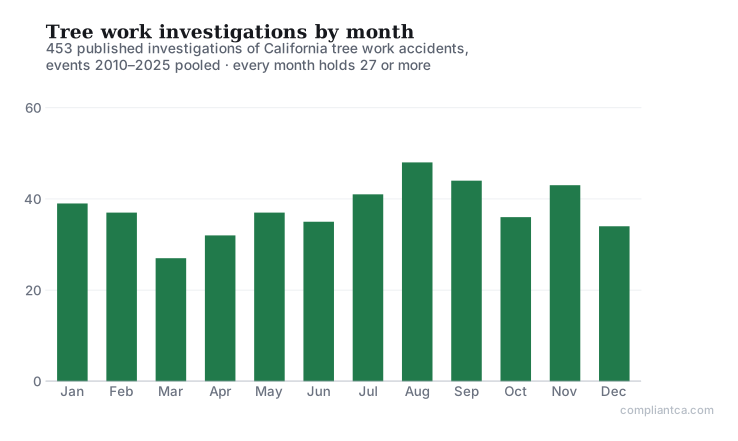
| Month | Investigations |
|---|---|
| Jan | 39 |
| Feb | 37 |
| Mar | 27 |
| Apr | 32 |
| May | 37 |
| Jun | 35 |
| Jul | 41 |
| Aug | 48 |
| Sep | 44 |
| Oct | 36 |
| Nov | 43 |
| Dec | 34 |
Compare this to heat illness, where 95% of events land in five months: tree work’s calendar is nearly flat. Winter storm cleanup, spring growth, summer trimming, fall preparation — the file count says the risk travels with the work, all year. For a crew, the practical reading is that there is no season when the pre-climb inspection matters less.
What gets cited after
On tree-work investigations with events from 2020 onward (the window our citation data covers), the citations that follow name the tree-work standards themselves:
| Standard | Citations |
|---|---|
| §3421 — Tree Work, General | 94 |
| §3427 — Tree Work, Safe Work Procedures | 53 |
| §3395 — Heat Illness Prevention | 40 |
| §3203 — Injury and Illness Prevention Program | 25 |
| §342 — Reporting Work-Connected Fatalities and Serious Injuries | 21 |
§3427 is the pre-climb standard — safe work procedures beginning with inspection by a qualified tree worker before anyone leaves the ground — and in the landscaping citation data it carries the highest average penalty in the industry’s top ten. §3421(a) also requires the §3203 IIPP by name, which is why the written program appears in the wreckage of tree-work investigations too.
Free Tailgate Meeting Log. One sheet per crew safety meeting — date, topics, leader, and a print-and-sign crew list. The mechanisms above are tailgate topics. PDF, no account. Request the log →
Methodology
CompliantCA computed this analysis from the OSHA accident investigation tables in the U.S. Department of Labor enforcement dataset (the OSHA Information System), which includes Cal/OSHA because California operates an OSHA-approved State Plan; eight of the 453 files are federal-jurisdiction employers, the rest Cal/OSHA investigations. Scope: investigation summaries linked to California inspections with event dates January 2010 through December 2025 whose event description names tree work — the word-boundary patterns TREE, PALM, CHIPPER, ARBORIST, LIMB, BRANCH, with substring false positives (street, hedge trimmers, print trimming machines) checked and excluded by eyeball; the match set was reviewed by hand. Landscaping as an industry (NAICS 5617) is a wider set — 835 investigations, 231 fatal — that includes non-tree events; this page counts tree-described events in any industry. Mechanism rows count description patterns and can overlap. Fatality shares compare against all published California investigations in the same window (3,473 fatal of 20,279). Publication lag governs the data: investigation summaries release after cases close, typically years later, so recent years are incomplete and no year-over-year claim is valid from these files; all claims here are composition on the closed-case set. Citation counts cover events from 2020 onward only, matching our enforcement-data window, excluding rows flagged deleted, grouped to the base section. Data as retrieved 2026-08-29.
An investigation count says what was reported and investigated, not the full toll — and not what any employer must do. The tree-work standards themselves do: §3421, §3427, and their article of Title 8.
Frequently asked questions
How dangerous is tree work in California, by the investigation data?
Of the 453 published California tree work accident investigations with events from 2010 through 2025, 130 — 29% — involved a death, against a 17% fatality share across all published California investigations in the same window. Tree work case files are fatal at nearly twice the all-industry rate.
What kills tree workers in California?
In the published investigations 2010–2025: falls involving a tree or palm appear in 262 case files (69 fatal), being struck or crushed by a tree, branch, or limb in 138 (49 fatal — the highest fatality ratio of the major mechanisms), chippers in 22 (7 fatal), and electrocution near power lines in 13 — of which 11 were fatal, the deadliest circumstance in the data.
Is there a season for tree work accidents?
No. The 453 published investigations spread across every month — from 27 in March to 48 in August — with no summer spike like heat illness shows. Tree work risk is year-round, which matches how the work is scheduled.
What does Cal/OSHA cite after a tree work accident?
On investigations with events from 2020 on, the tree-work standards themselves lead: §3421 (Tree Work — General) with 94 citations and §3427 (Tree Work — Safe Work Procedures, starting with pre-climb inspection) with 53, followed by §3395 heat illness prevention (40) and the §3203 IIPP (25).